

Why Ayurveda Traces Skin and Hair Problems Back to Digestion?
Most people approach skin problems from the outside: the right cleanser, the right serum, the right topical treatment. They approach hair problems the same way: oils, shampoos, scalp treatments. These approaches produce inconsistent results because they address the surface without touching what's driving the problem underneath.
Ayurveda takes a different starting point: the skin is not a separate system. It's the visible result of how well the body is digesting, absorbing, and distributing nourishment through a sequence of seven tissues, and when that sequence breaks down anywhere upstream, the skin and hair show it.
This is the core logic behind Ayurvedic skin treatment that treats skin conditions through digestion, liver function, and blood quality rather than through topical protocols alone, and it explains why patients with chronic skin issues often see results through internal treatment that years of external products didn't produce.
The Dhatu Sequence: Why Digestion Determines Skin Quality
Ayurveda describes the body as being built from seven sequential tissues, the Saptadhatu. Food is digested into the first tissue, Rasa Dhatu (lymph and plasma), and this nourishes each subsequent tissue in order: Rasa nourishes Rakta (blood), Rakta nourishes Mamsa (muscle), and so on through Meda (fat), Asthi (bone), Majja (marrow), and Shukra (reproductive tissue).
Classical Ayurveda gives the full timeline as approximately 30-35 days. The food you ate at breakfast becomes Rasa within 24 hours, Rakta within 3-5 days, Mamsa within 6-10 days, and so on through the sequence.
The quality of your digestion directly impacts the quality of your tissues. If nourishment is incomplete early on, later tissues receive less support. This is why Ayurvedic skin treatment and Ayurvedic hair treatment begin with the digestive system, not the skin or scalp.
Bhrajaka Pitta: The Sub-Dosha That Governs Skin Directly
Within the Pitta dosha, five sub-doshas govern specific functions. Bhrajaka Pitta is in charge of keeping body temperature stable as well as providing the skin its colour and shine. Bhrajaka Pitta causes various drugs, Abhyanga (oil massage), Parisheka (hot water or oil pouring), Avgaha (tub bath), and Lepa (paste) to be absorbed and digested.
Pachaka Pitta is the master Pitta functionally equivalent to Jatharagni, the central digestive fire. Classical Ayurveda treats Pachaka Pitta first in any Pitta disorder, because as the root Pitta normalises, the downstream sub-doshas often correct spontaneously.
The practical implication is significant. Bhrajaka Pitta, the sub-dosha directly governing skin, is downstream of Pachaka Pitta, the digestive fire. When Pachaka Pitta is disturbed through irregular eating, processed food, stress, or incompatible food combinations, it disrupts the downstream sub-doshas, including Bhrajaka.
If one experiences sluggish bowels on a daily basis, no skin care product will help improve surface appearances. This statement from classical Ayurvedic medicine captures the clinical reality that drives the approach to Ayurvedic skin treatment.
Rakta Dhatu and Skin Conditions
Rakta implies the liquid that gets nourished by the essence part of food, which is the cause for skin complexion, strength, and immunity. Blood, Pitta, liver disorders, and skin conditions are interrelated.
Ranjaka Pitta, seated in the liver and spleen, governs the transformation of Rasa Dhatu into Rakta Dhatu. Disturbed Ranjaka Pitta manifests in the classical model as liver heat, skin discolouration, and blood quality issues.
Balanced Rakta shows up as a healthy glow, clear skin tone, stable body temperature, and grounded energy. Imbalanced Rakta may show as inflammation, sensitivity, redness, breakouts, or irritability. This is why Kushtha, the classical Ayurvedic category covering skin disorders including psoriasis and eczema, is treated through procedures that purify Rakta Dhatu, not through topical application alone.
How Dubai's Lifestyle Creates the Conditions for Skin and Hair Problems
The specific lifestyle patterns common in Dubai's working population create a predictable set of digestive disturbances that Ayurveda would identify as the upstream causes of skin and hair conditions.
Irregular meal timing eating late, skipping meals, or eating at different times each day disrupts Jatharagni. High-stress corporate and professional environments elevate Pitta.
The skin and hair conditions most common among Dubai residents acne in adults, chronic dry skin, hair thinning, premature greying, persistent dandruff, eczema flares map almost precisely onto what Ayurveda would predict from this lifestyle pattern.
What Ayurvedic Skin Treatment Actually Involves
Effective Ayurvedic skin treatment is not a facial or a herbal mask in isolation. At Ayur Vaidya, it follows a sequence that reflects the classical logic: identify the constitutional type (Prakriti) and current imbalance (Vikriti), assess digestive function and Agni quality, address the internal cause through dietary modification, herbal medicines, and Panchakarma where indicated, and then apply external treatments that support the internal correction.
For Pitta-driven skin conditions inflammatory acne, rosacea, eczema with heat, psoriasis the internal protocol focuses on cooling Pitta, purifying Rakta, and improving liver function through herbs including Manjishtha, Neem, Amalaki, and Guduchi. Virechana is indicated when the condition is systemic.
For Vata-driven skin conditions chronic dryness, premature ageing, flaking, lack of lustre the protocol focuses on nourishing Rasa and Rakta Dhatu and restoring adequate moisture and oil to the skin through internal oleation, Abhyanga, and Shirodhara.
For Kapha-driven conditions congested, oily skin, cystic acne, persistent dandruff the approach begins with Deepana-Pachana (digestive stimulants) and a light diet to reduce Ama and Kapha accumulation, followed by appropriate external treatments.
Final Take
The connection between digestion and skin quality isn't a philosophical position in Ayurveda; it's a structural one, built into the dhatu chain from Rasa through Rakta to the skin itself. Ayurvedic skin treatment that addresses Agni, Pitta, and Rakta Dhatu from the inside produces lasting changes in skin and hair that surface-only treatments don't reach. Ayur Vaidya's Ayurvedic consultation and treatment programme provides a systematic internal and external approach under certified practitioners. Book a consultation at +971 43 586 892.
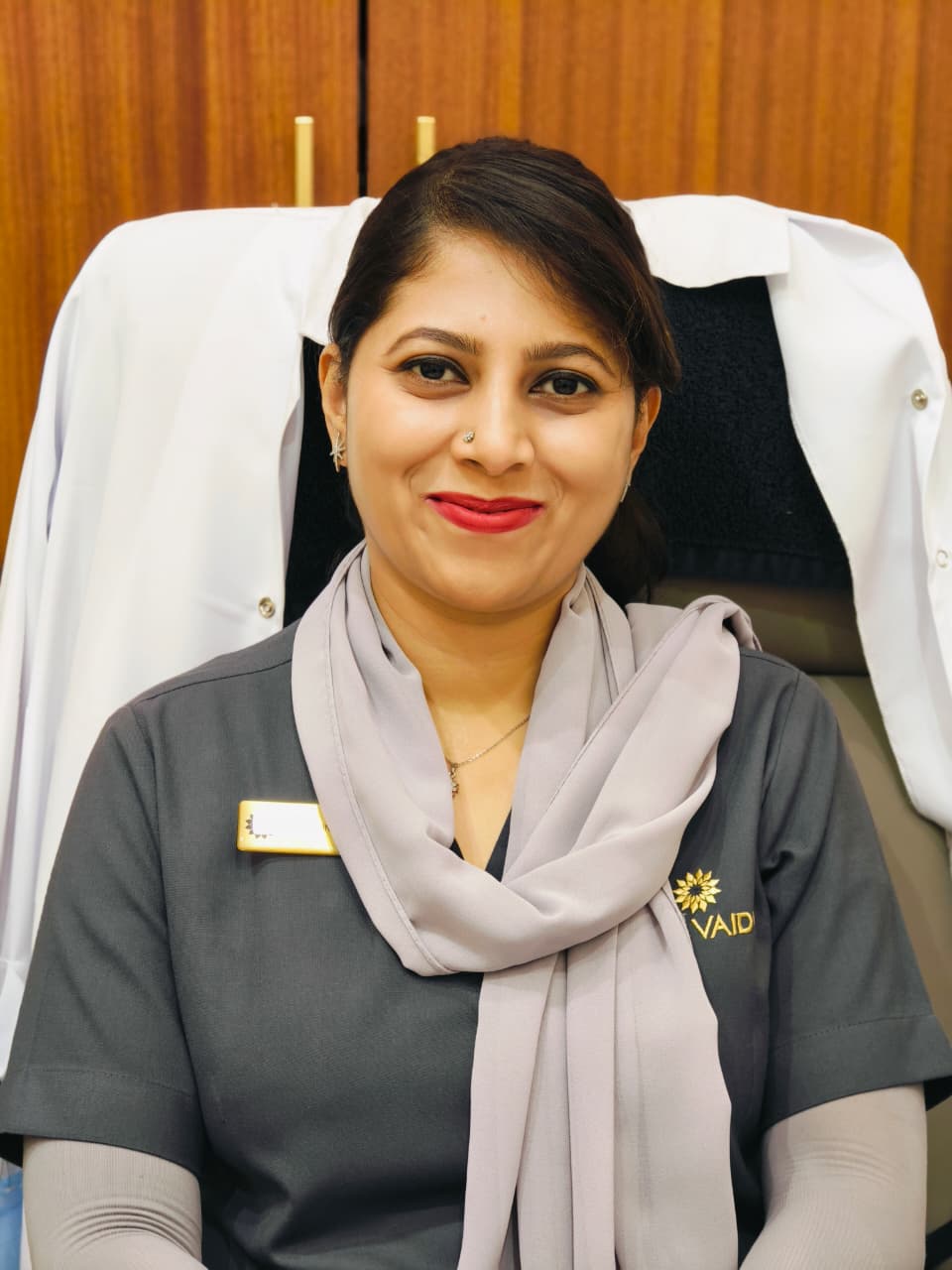
Dr. Subina Parveen
Frequently Asked Questions
Why does Ayurveda treat skin conditions through digestion?
Because in the Ayurvedic framework, skin is an upadhatu (secondary tissue) of Rakta Dhatu, which is formed from Rasa Dhatu, which is the direct product of digestion. A digestive system that produces low-quality Rasa sends that deficiency through the entire dhatu chain; the skin receives the downstream consequence. Treating only the skin surface while the digestive driver remains active produces temporary results.
What is Bhrajaka Pitta and why does it matter for skin?
Bhrajaka Pitta is the sub-dosha responsible for skin colour, lustre, and temperature regulation. It also governs the skin's ability to absorb and metabolise topically applied substances, including medicinal oils. Bhrajaka Pitta is downstream of Pachaka Pitta, the digestive fire. When digestion is disturbed, Bhrajaka Pitta is affected, and skin quality reflects this.
What Panchakarma procedure is most relevant for skin conditions?
Virechana therapeutic purgation is the classical Panchakarma procedure for Pitta and Rakta-driven skin conditions, including psoriasis, eczema, acne, and vitiligo. Clinical studies report 50-80% symptom improvement in these conditions through Virechana. It is performed under the guidance of a certified Ayurvedic practitioner after appropriate preparation.
Does Ayurvedic skin treatment involve only internal treatment?
No. The internal and external approaches are complementary. External treatments, including Mukha Abhyangam, Shiro Abhyanga, Lepa, and Shirodhara, support and reinforce the internal treatment, but they don't replace it. Ayur Vaidya provides both as part of a personalised treatment plan.


